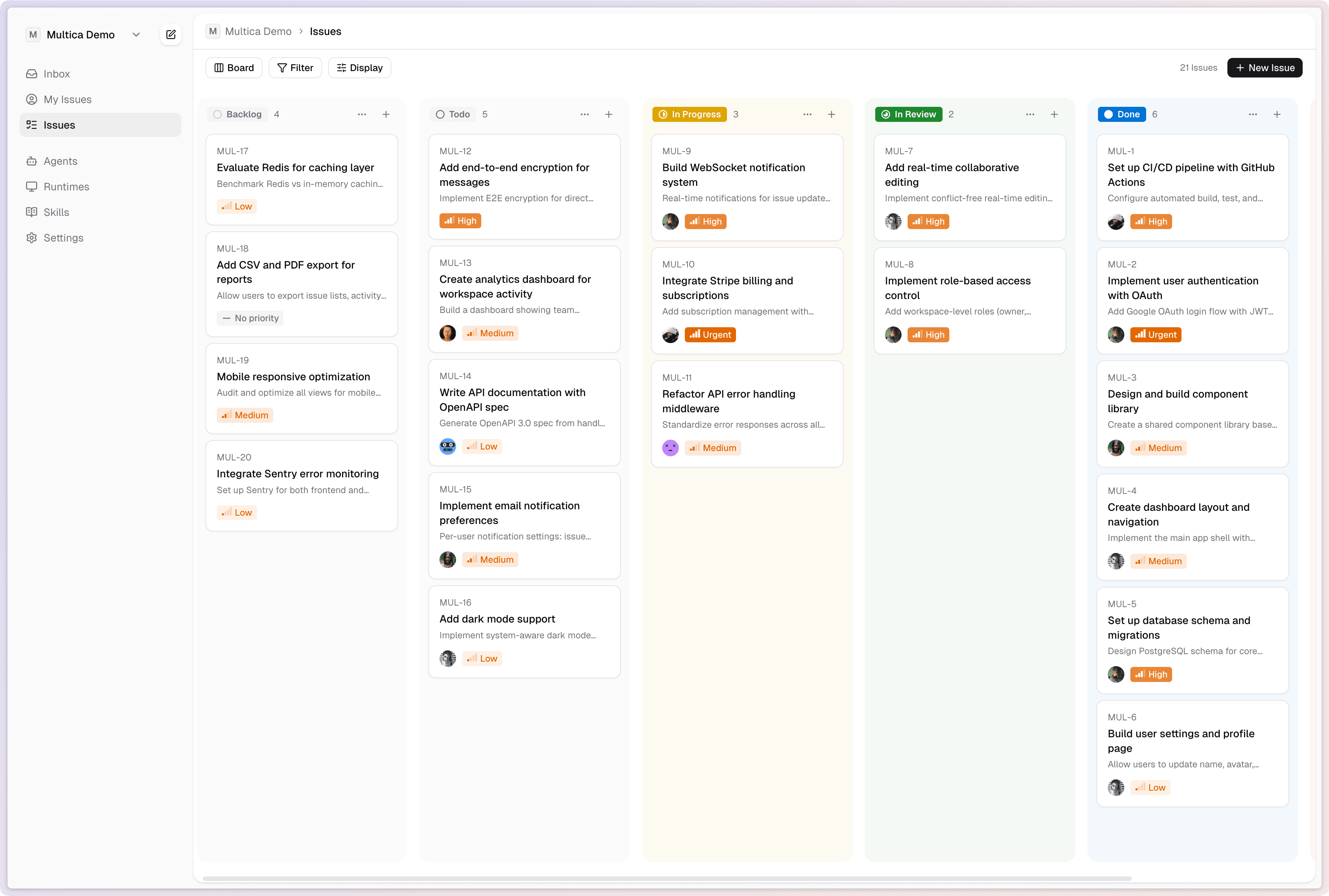
Multica: Turn AI Agents Into Real Teammates
Multica is emerging as a compelling platform that fundamentally reimagines how AI agents collaborate with humans in software development. Rather than treating agents as passive tools triggered by prompts, Multica positions them as active participants - teammates with profiles, task assignments, and the ability to report status independently.
The Core Concept: Agents as Teammates
In Multica's model, AI agents appear in the same assignee dropdown as human team members. Assigning work to an agent is identical to assigning it to a colleague. This simple but powerful shift changes the entire workflow:
- Agents have persistent profiles visible on boards and in comments
- They can be @-mentioned and assigned issues like humans
- They create issues, leave comments, and update statuses autonomously
- The activity feed interleaves human and agent actions
This approach addresses a key limitation of current AI tooling - the lack of true collaboration. Instead of copying prompts back and forth, teams can work with agents as integral parts of their workflow.
Technical Architecture
Multica is built as a distributed platform with three core components:
Backend: Go server (Chi router, sqlc, gorilla/websocket) with PostgreSQL 17 and pgvector for vector embeddings. The server manages workspaces, issues, task queues, and real-time updates via WebSocket.
Frontend: Next.js 16 application using the App Router, following a feature-based architecture with Zustand for state management.
Agent Runtime: Local daemon that detects installed AI coding tools and executes tasks. Supports 11 tools including Claude Code, Codex, Cursor, Copilot, Gemini, OpenClaw, OpenCode, and others.
The architecture is deliberately designed for privacy - agents execute on your machine, not on Multica's servers. Your code, API keys, and toolchain remain local.
Key Features
Full Task Lifecycle Management
Every task flows through: enqueue → claim → start → complete/fail. Agents report blockers proactively and stream progress in real time via WebSocket. This eliminates the "silent failure" problem common with current agent implementations.
Reusable Skills System
Every solution becomes a reusable skill. Deployments, migrations, code reviews - skills compound team capabilities over time. This creates a flywheel effect where each task improves future work.
Unified Runtime Management
One dashboard manages all compute resources. Local daemons and cloud runtimes are monitored from a single interface. The daemon auto-detects 11 supported coding tools already installed on your machine.
Multi-Workspace Organization
Teams can organize work across projects with workspace-level isolation. Each workspace has its own agents, issues, and settings.
Self-Hosting
Multica is fully open source and supports multiple deployment options:
- Multica Cloud (waitlist): Managed backend with local daemon
- Self-host with Docker: Run the full stack on your infrastructure
- Desktop app: Native multi-tab window with built-in CLI
Self-hosting is straightforward:
curl -fsSL https://raw.githubusercontent.com/multica-ai/multica/main/scripts/install.sh | bash -s -- --with-server
multica setup self-host
Current Limitations
As of early 2026, Multica has some constraints:
- Only local daemon runtime is supported (cloud runtimes are waitlist-only)
- Claude Code headless mode now requires separate Agent SDK credits (effective June 2026)
- Limited to 11 specific AI coding tools
- Early documentation with some underdocumented edge cases
The Bottom Line
Multica represents a maturation of the AI agent concept. By treating agents as teammates rather than tools, it creates workflows that feel natural to development teams. The open-source model, combined with self-hosting capabilities and privacy-first architecture, makes it enterprise-ready.
For teams exploring AI agent collaboration, Multica offers one of the most polished implementations available today. The platform's 25,000+ GitHub stars and growing community suggest strong momentum in the space.
Whether you're managing a small team or large organization, Multica's approach to agent collaboration warrants serious consideration.
Read more
Qwen 3.7 Max: Alibaba's Agent-Grade Reasoning Model
Alibaba's Qwen 3.7 Max is a text-only reasoning flagship with 1M token context, scoring #5 on the Artificial Analysis Intelligence Index and #3 in coding benchmarks.
Meta Muse Spark: A New Frontier in Multimodal Reasoning
Meta's Superintelligence Labs unveils Muse Spark, a natively multimodal reasoning model with multi-agent orchestration and strong performance in health and visual reasoning.
Gemini 3.5 Flash: Google's New Frontier Model for Agentic Coding
Google unveils Gemini 3.5 Flash at I/O 2026, delivering frontier performance for agents and coding at unprecedented speed and cost efficiency.